Recently, almost unknowingly, I assigned myself a homework exercise: to look for and notice when I feel joy.
I say ‘almost unknowingly’ because this wasn’t really planned. It wasn’t an instruction I read in a self-help book; it isn’t a 30-day challenge. It has just kind of evolved as I started being kinder to myself and working with my neurodivergent brain. I now have greater capacity to notice things; stopping to ‘smell the roses’ is easier. And the best bit? This assignment isn’t being graded and doesn’t really have any rules.
Except for a clarification: this isn’t a pleasure-seeking exercise. I’m not loading myself up with enjoyable experiences, activities or new things; instead, it is simply discovering joy inside everyday moments.
Like scrolling through Facebook and seeing my friends celebrate the achievements of their children, not in a competitive ‘my child is better than yours’ way, but in a ‘look at my child doing something they love to do’ way. I guess you could class this as second, or maybe third-hand joy. The joy for me comes from recognising that the child is seen by their parent.
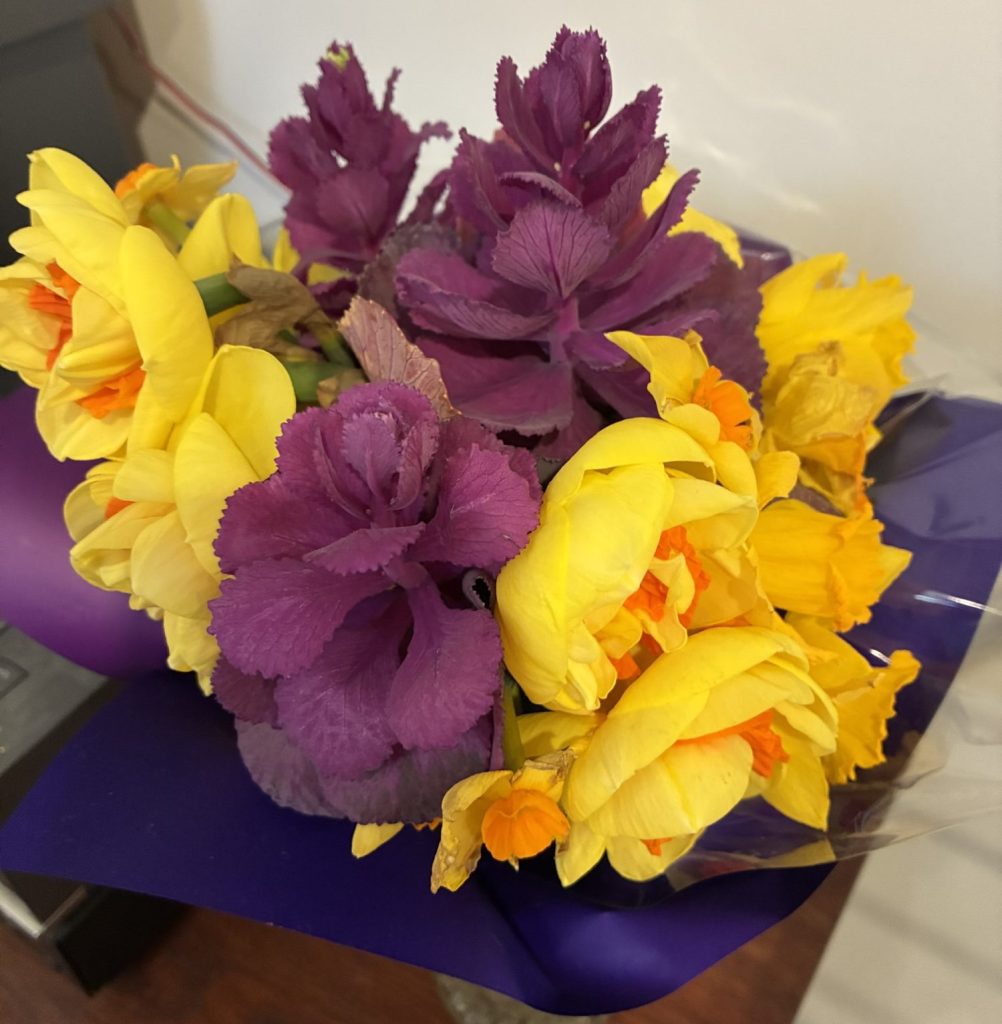
And right now, I’m looking at the small bouquet of flowers that I arranged myself and noticing how the sunlight is hitting them and making them glow. Flowers purchased the same day we finally buried our beloved dog’s ashes. The flowers now taking up the spot where his box of ashes had been and being illuminated by the same sunbeam he used to enjoy so much.
A reminder that joy can exist alongside sadness. And just like in the movie Inside Out, a reminder that both emotions help us process grief.
When speaking about mental health, we often hear that ‘practicing gratitude’ is a powerful tool in improving wellbeing. While I don’t disagree, I also worry that we can, and have been guilty of this myself, weaponise this practice. By saying to those who are struggling, “just look on the bright side” or “it could be worse”. Pushing those in pain to reach for meaningless positivity, sometimes for the sake of relieving our own discomfort.
Joy doesn’t have to be evidence that everything is ok. Noticing joy isn’t a magic eraser that eliminates suffering. And I don’t want to use it as an excuse to ignore the problems of the world. It may not be able to dismantle the systems of oppression, but maybe it is noticing the light that is emerging from the cracks.
I think it is a practice I want to continue, of course with no rules. I’m noticing joy in the fact that this reflection has gone on an unexpected flight, becoming something quite different to what I initially thought it would be.
Which reminds me of another movie and that famous monologue from a fictional Prime Minister:
“If you look for it, I’ve got a sneaky feeling you’ll find that love (joy) actually is all around.”
